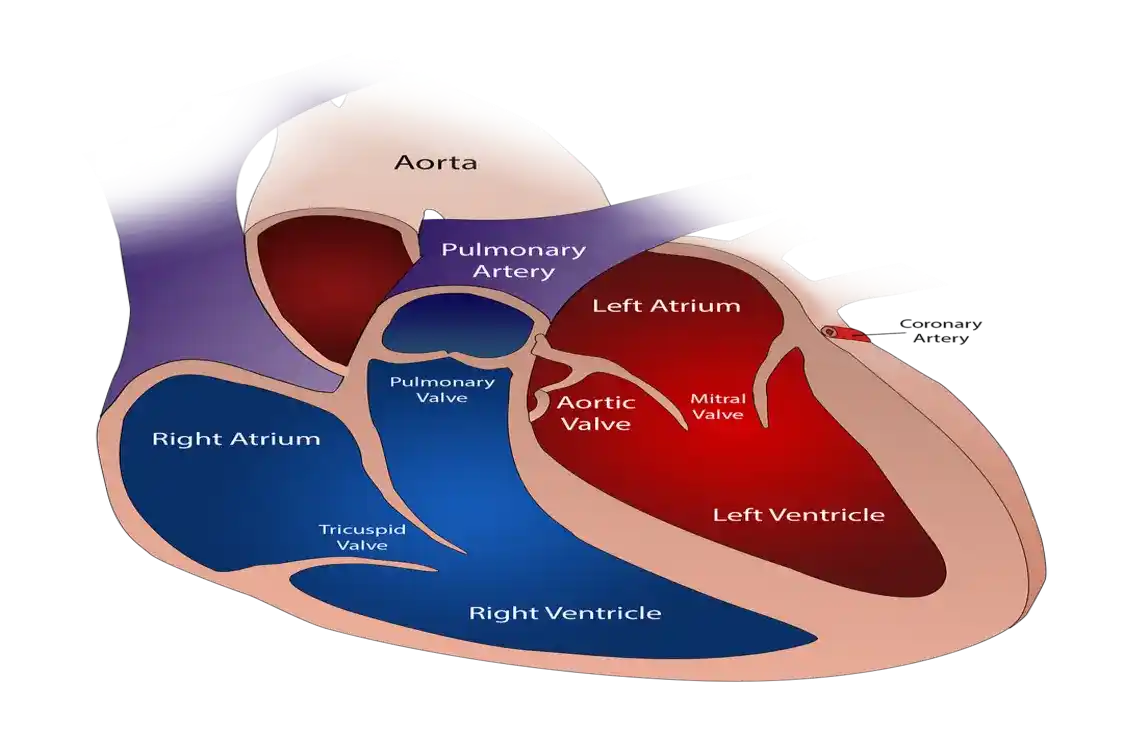
Aortic stenosis occurs when the aortic valve does not open fully during systole. This limits the left ventricular ejection. The aortic valve is located at the beginning of the aorta, at the exit of the left ventricle. Because the valve is narrow in aortic stenosis, blood flow from the left ventricle into the aorta is difficult.
Causes of Aortic Stenosis
- One of the most common causes of aortic stenosis is valve degeneration with aging. Initially, the aortic valve is normal, but with advancing age, the valve becomes fibrous and calcified, eventually narrowing.
- In other cases, the valve is abnormal from birth, especially the one known as the “bicuspid aortic valve.” This undergoes degenerative changes throughout life and also eventually narrows. Bicuspid aortic valve is observed in up to 2% of the general population.
- An increasingly rare cause is rheumatic valvular disease. This is a consequence of rheumatic fever. In this case, the valve becomes inflamed and scarred, causing deterioration throughout life. It is still common in developing countries.
- Occasionally, the obstruction is not observed in the valve itself, but in the root of the aorta or in the left ventricular outflow tract. In these cases, the narrowing is called supravalvular or subvalvular stenosis, respectively.
Symptoms
Aortic stenosis is usually tolerated fairly well for many years until it becomes severe. In this case, the narrowing is such that flow through the valve is significantly reduced. This has an impact on the left ventricle, causing it to hypertrophy and even dilate, decreasing its contractility.
Patients with severe aortic stenosis often report decreased exercise tolerance, typically due to dyspnea (shortness of breath) or exertional angina. Diagnosis is based on Doppler echocardiography. This test can demonstrate ventricular hypertrophy and valve involvement, and estimate the degree of obstruction.
Severe aortic stenosis can lead to death if left untreated. The usual treatment is surgical implantation of a prosthetic valve. Transcatheter implantation of a prosthetic aortic valve is also possible. This involves inserting the prosthetic valve with a catheter through the femoral artery; from there, it is passed up the aorta until it is positioned over the native aortic valve.
If the patient does not undergo surgery, life expectancy is very short, generally 3 to 5 years. Death usually occurs as the disease progresses to a terminal stage. However, it can also be caused by sudden death, especially exercise-related death, although this is rare.
Aortic Stenosis: Diagnosis and Treatment